Federal Health Officials Participate in Food Allergy Fund Leadership Forum Focused on Research and Innovation


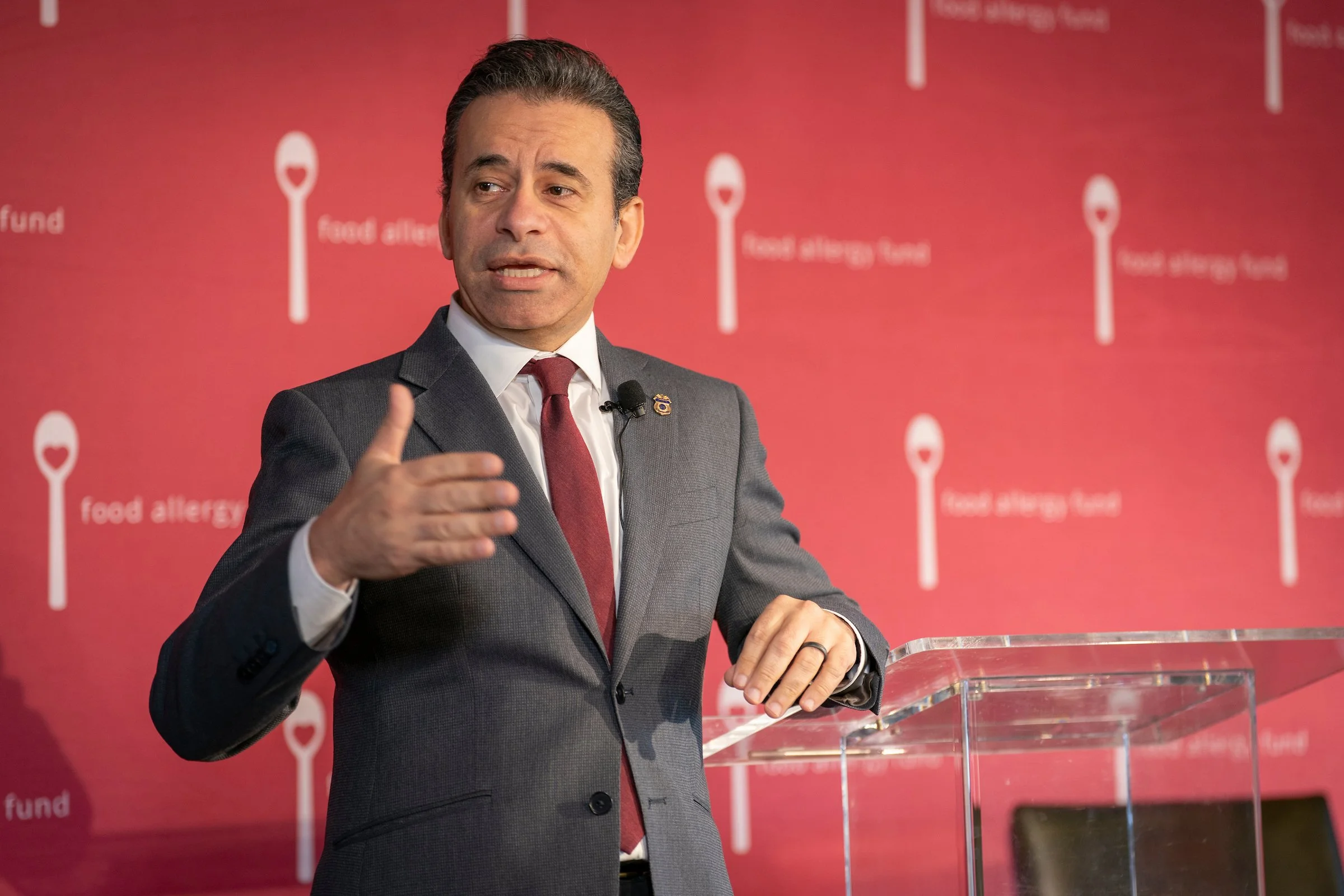

Photo Credit: Food Allergy Fund
WASHINGTON, November 17, 2025 (WELLNESS INTERVIEWS) — Health research nonprofit the Food Allergy Fund, an organization specializing in funding food allergy prevention and treatment research, hosted its Leadership Forum in Washington, D.C. today, bringing together senior federal health officials, academic leaders, and industry experts. The meeting focused on research developments and national strategies to address food allergies, which affect 1 in 13 children and 1 in 10 adults.
Wellness Interviews
♾️
Wellness Interviews ♾️




The event featured remarks from U.S. Department of Health and Human Services Secretary Robert F. Kennedy Jr., National Institutes of Health Director Dr. Jay Bhattacharya, Food and Drug Administration Commissioner Dr. Marty Makary, and Advanced Research Projects Agency for Health Director Dr. Alicia Jackson.
Ilana Golant, founder and CEO of the Food Allergy Fund, addressed the need for increased national attention on the issue.
“Food allergies remain one of the most overlooked and underfunded public-health challenges. Also, they may be the canary in the coal mine for a broader immune-health crisis,” said Golant.
Secretary Kennedy discussed the agency’s priorities related to the condition.
“Under my leadership, HHS is making it a top priority to uncover the root causes of food allergies. Thanks to President Trump’s leadership and his Make America Healthy Again vision, we’re confronting the childhood chronic disease epidemic at its source — restoring the health of our children and the nation,” said Kennedy.
NIH Director Bhattacharya highlighted how food allergy research aligns with the agency’s broader mission.
“As a cornerstone of NIH’s mission, nutritional science research advances gold-standard, evidence-based discoveries that empower all Americans to live healthier lives and reduce the burden of chronic disease,” said Bhattacharya.
Golant noted that nearly half of all food allergies now begin in adulthood and emphasized the significance of federal engagement.
“Food allergies remain one of the most overlooked and underfunded public-health challenges. Also, they may be the canary in the coal mine for a broader immune-health crisis. By breaking down silos and uniting science, policy, and innovation, we can unlock solutions that reach far beyond food allergies,” said Golant.
Dr. Alicia Jackson, the newly appointed director of the Advanced Research Projects Agency for Health (ARPA-H), discussed the agency’s expanding investment in food allergy science.
“I came to lead ARPA-H to tackle and to solve the major health challenges facing Americans today, like the food allergy crisis. ARPA-H exists for one purpose: to take on the challenges that are too big, too complex, and too high-risk for traditional funding or industry. We are calling on the best researchers, entrepreneurs and leaders to send us their brightest minds with the passion, expertise and ideas that can create a future where preventing and eliminating food allergies is fully possible,” said Jackson.
The forum also showcased emerging technologies being developed by health-tech companies, including AI-powered wearables capable of detecting early signs of anaphylaxis, biologic drug candidates, and new immunotherapy tools such as toothpaste-based treatments.
During the event, the Food Allergy Fund announced the launch of its Microbiome Collective, a multi-institution collaboration aimed at identifying the root causes of food allergies and related immune-driven diseases. According to the company, the initiative expands on research already funded by the organization, including a first-in-human trial at Boston Children’s Hospital in which participants demonstrated increased peanut tolerance following a microbiota transfer treatment.
Dr. Rima Rachid, director of the Food Allergy Program at Boston Children’s Hospital, commented on the research model.
“Previous microbiome studies have been limited by small sample sizes, different methodologies, and isolated datasets. FAF’s Collective model creates the scale and standardization needed to link specific microbiome mechanisms to disease, and, more importantly, to develop precision treatments,” said Rachid.
Dr. Susan Lynch of the Benioff Center for Microbiome Medicine at the University of California, San Francisco, noted the broader implications of microbiome science.
“We believe food allergies are just the tip of the iceberg. How we understand and modulate the microbiome could transform how we prevent and treat a whole spectrum of inflammatory and autoimmune diseases,” said Lynch.
According to the company, the Food Allergy Fund will issue a Request for Proposals in the coming weeks for research focused on new diagnostics, treatments, and prevention strategies. Projects that demonstrate scalability across multiple research sites will be prioritized.
For more information, visit www.foodallergyfund.org.
Source: Food Allergy Fund